Documents and length of stay
Most nationalities enter Chile visa-free, as tourists, for up to 90 days. That is not universal: the list changes and depends on the country that issued your passport, so the first task of the trip is to confirm it with the National Migration Service (Servicio Nacional de Migraciones).
At immigration control you will need a valid passport, and you may be asked for an onward ticket and where you will be staying. It is worth having both on hand, even though they are rarely checked.
The Policía de Investigaciones (PDI, Chile's investigative police) issues a tourist card right there, on paper or digitally. It is proof that you entered legally and you will be asked for it again when you leave the country: keep it with your passport, not in your pants pocket.
One detail worth taking advantage of: by showing that card and your passport, non-resident foreigners who pay in dollars or with a foreign card are exempt from IVA (Chile's value-added tax) at hotels. That is a 19% difference, and you have to ask for it at check-in, not afterward.
What you can't bring in
On arrival you must fill out an SAG declaration (Servicio Agrícola y Ganadero, the Agricultural and Livestock Service). It is not a formality: Chile is cut off from the rest of the continent by the Andes and the desert, and it protects that isolation with steep fines.
Fruit, vegetables, seeds, meat, dairy, honey and untreated wood products are not allowed. When in doubt, declare it: declaring something that isn't permitted means throwing it away; not declaring it means a fine.
Money
The currency is the Chilean peso. It has no cents and prices are written as whole numbers: “12.500” is twelve thousand five hundred pesos.
- Cards are accepted almost everywhere in the cities. In small towns along the Carretera Austral and in Tierra del Fuego, they are not.
- Head out on the road with cash. There are no ATMs inside Torres del Paine, and the only one in Puerto Williams runs out of bills.
- ATMs charge a fee for withdrawals with a foreign card, so it makes sense to withdraw larger amounts less often.
- The usual tip in restaurants is 10%, and it is often suggested on the bill. It is voluntary and you can decline it without awkwardness.
Language
Spanish is spoken, with a Chilean accent and plenty of slang. Tourism services in Punta Arenas, Puerto Natales and Coyhaique have English speakers; beyond those, much less so. A translation app downloaded for offline use solves almost everything.
Connectivity
The cities have good mobile coverage, and there is wifi in lodgings and cafés. The roads and the parks do not. Between Coyhaique and Villa O'Higgins, around Bahía Inútil or inside Torres del Paine there are long stretches with no signal from any carrier.
Two things that prevent scares:
- Download maps for offline use before leaving the city.
- When you go hiking, tell someone your plan for the day and your estimated return time.
A local SIM card or an eSIM is easy to get in any city and costs far less than roaming.
Health and safety
Chilean Patagonia is a safe, calm destination. The real risks are not the ones you might imagine:
- The wind. In spring and summer it frequently exceeds 100 km/h in Magallanes. It can knock a person over, fling car doors open and lower the wind chill by several degrees. This is not an anecdote: it is the most common cause of minor accidents.
- Solar radiation. The ozone layer is thinner at this latitude. The sun burns on a cloudy day at 8 °C. Sunscreen and sunglasses, always.
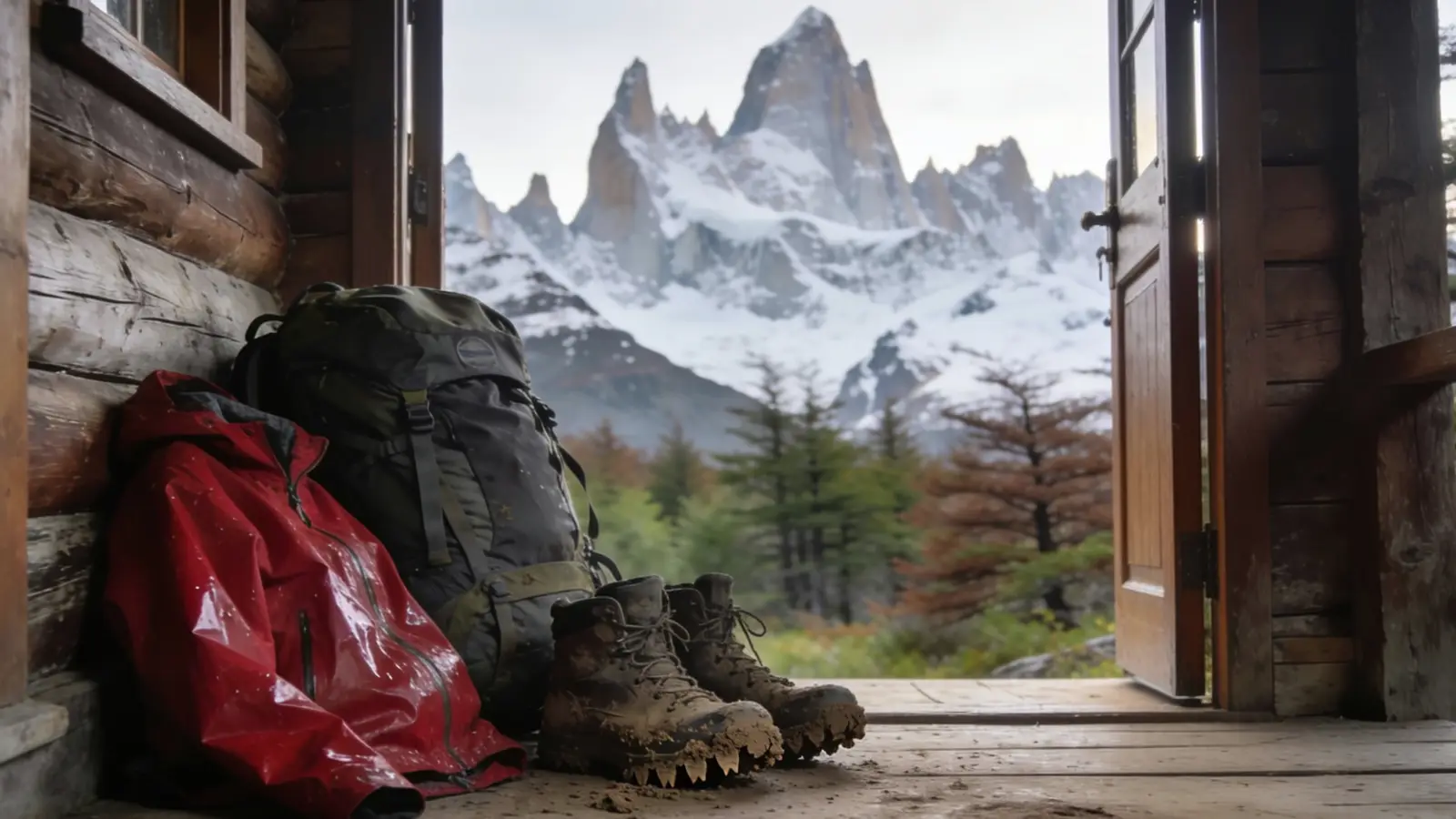
- The weather changes within an hour. Sun, wind and sleet on the same hike is normal. Three layers —a thermal base layer, fleece and a waterproof windbreaker— cover all twelve months of the year.
- Tap water is safe to drink in every city on the portal.
- There is no altitude sickness: all of this is almost at sea level.
In an emergency: 131 ambulance, 132 fire department, 133 Carabineros (Chile's national police). There are hospitals in Coyhaique, Punta Arenas and Puerto Natales; Porvenir and Puerto Williams have small community hospitals, and serious cases are flown out. Travel insurance that covers evacuation stops being a luxury as soon as you leave the main road.
Plugs and power
220 volts, 50 Hz, plugs with two or three round pins (types C and L). Visitors from North America will need an adapter and, depending on the device, a voltage converter.
Accessibility
It is uneven, and worth knowing in advance. The larger cities have curb cuts, hotels with accessible rooms and some adapted museums; mountain trails, generally, do not.
There are exceptions that do work: several viewpoints and visitor centers have boardwalks, and some operators offer accessible boat trips. Since the details change by season and by provider, the honest advice is to ask before booking, with your specific needs in writing. Each destination's section lists the phone numbers of the portal's businesses so you can do that.
If you cross into Argentina
Half of Patagonia is explored by crossing the border. The crossing itself is simple —passport and inspection at both customs posts— but there are two catches:
- With a rental car, you have to give notice in advance. The company must provide a notarized authorization and insurance that covers Argentina; the paperwork takes days, not hours, and without it you can't cross.
- The same SAG rules apply on the way back. Fruit bought in El Calafate stays at the border.
Last reviewed . Entry rules, timetables and departure frequencies change: when something hinges on your own situation, confirm it with the official source linked in the text.