By Equipo VivePatagoniaEditorial team
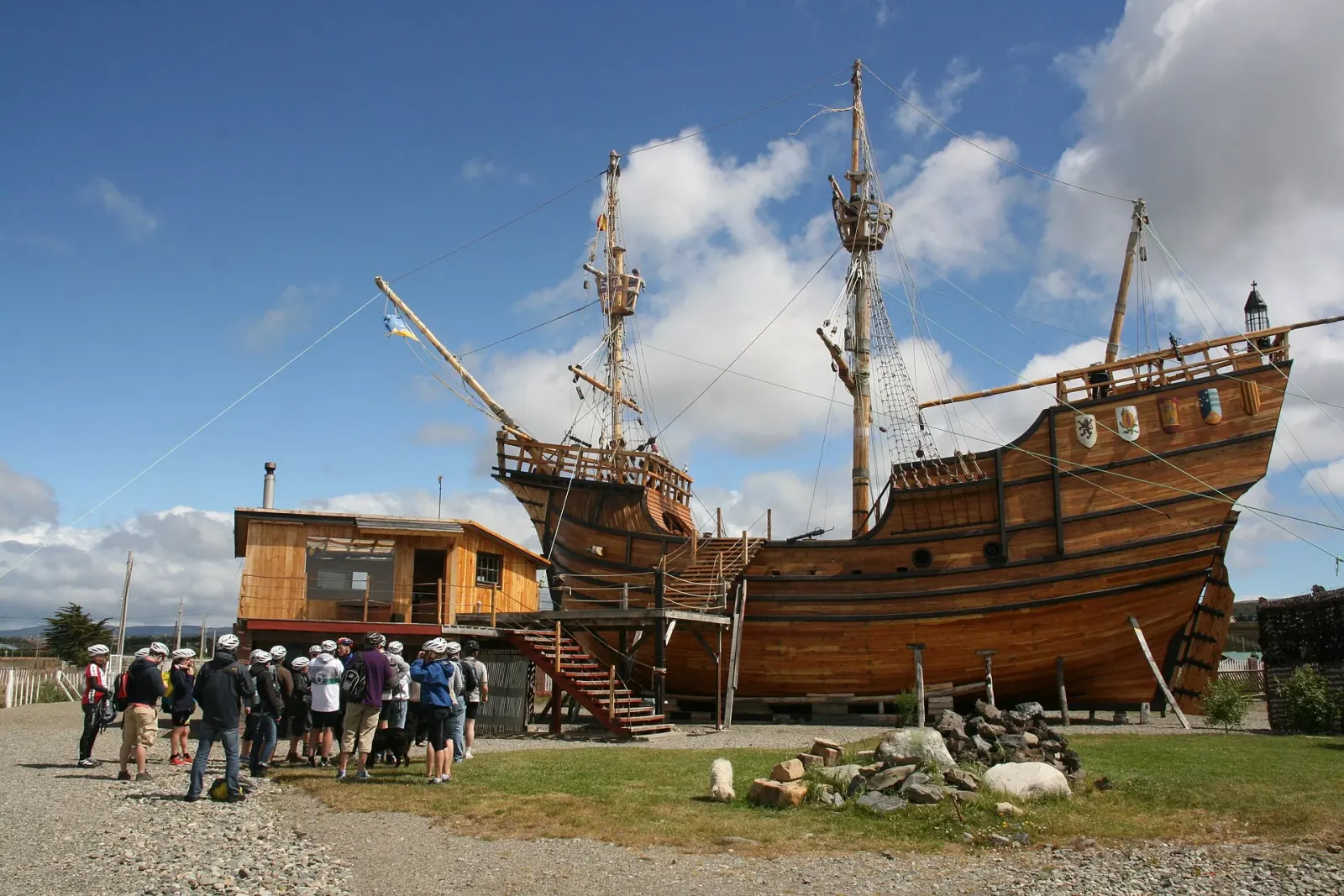
About seven and a half kilometers north of Punta Arenas, beside the Strait, a private museum has built four full-size ships using traditional shipbuilding techniques. Together they tell four chapters in the history of these waters.
The Nao Victoria
The first is a replica of the only ship in Ferdinand Magellan’s fleet to complete the first circumnavigation of the globe. In 1520 that expedition found and sailed through the passage that now bears his name. Stepping aboard gives you a sense of what it meant to cross oceans in a wooden hull that size.
Before the second: Puerto del Hambre
Sixty-four years after Magellan, Spain tried to stay. In 1584 Pedro Sarmiento de Gamboa founded two settlements on the Strait, Nombre de Jesús and Rey Don Felipe, the latter on the eastern shore of the Brunswick Peninsula, with some three hundred settlers. The site was inhospitable and the land was no good for farming: most died of starvation, and there were bloody mutinies. In 1587 the English privateer Thomas Cavendish passed through and called it Port Famine, Puerto del Hambre, the name that stuck.
The ruins of Rey Don Felipe, about 56 kilometers south of Punta Arenas, are a national Historic Monument.
The schooner Ancud
The second ship explains how Chile’s presence on the Strait began. In 1842 the intendant of Chiloé, Domingo Espiñeira, ordered the schooner Ancud built. It set sail in May 1843 under frigate captain Juan Williams, with 18 sailors, the naturalist Bernardo Philippi and two women aboard. On September 21 of that year it took possession of the Strait in Chile’s name, and on October 30 Fuerte Bulnes was inaugurated.
The fort didn’t last long: in 1848, because the land was no good for farming, the colony moved to Punta Arenas. The fort you visit today, south of the city, is a reconstruction inaugurated in 1944. Juan Williams, incidentally, left his surname on the map: Puerto Williams, on Isla Navarino, is named after him.
The Beagle
The third is the British Navy brig that, under the command of Robert FitzRoy, carried a young Charles Darwin. The Beagle spent years charting the southern coasts, and its name lives on in the channel that separates the main island of Tierra del Fuego from Isla Navarino. Some of what Darwin observed on that voyage fed, years later, into “On the Origin of Species.”
The James Caird
The fourth is the smallest: a replica of the Endurance’s lifeboat. In April 1916, with his ship lost in the Antarctic ice, Ernest Shackleton set out from Elephant Island in that open boat with five companions and crossed more than 1,300 kilometers of sea to South Georgia to seek help.
In the end, the rescue of the 22 men left behind on Elephant Island set out from Punta Arenas: the tug Yelcho, commanded by pilot Luis Pardo, sailed from here in August 1916 with Shackleton aboard and found every one of them alive.
Getting there
- It’s on the outskirts, about seven and a half kilometers north of downtown, along the coast.
- Hours and admission change: it’s best to confirm them before you go.
- Pair it with Fuerte Bulnes and Puerto del Hambre, south of the city, for a full day that tells the story of the Strait in order.
Last reviewed
See the full guide to Punta Arenas