By Equipo VivePatagoniaEditorial team
Some cities are best understood from a lookout. Punta Arenas is better understood by walking slowly through its cemetery.
A cemetery for every creed
The Cementerio Municipal (Municipal Cemetery) was founded in April 1894, on land north of the city that governor Manuel Señoret bought, by decree of President Jorge Montt. It lies about ten blocks from the main square. The Consejo de Monumentos Nacionales (National Monuments Council) describes it as Chile’s southernmost secular cemetery, a place that brings together the creeds and customs of the migrants who built the city, and it has been a Historic Monument since 2012.
Sara Braun’s gateway
You enter through an eclectic gateway with neo-Baroque lines, built between 1918 and 1923 with funding from Sara Braun, a businesswoman and philanthropist born in what is now Latvia and the widow of José Nogueira. Her mausoleum is one of the stops along the way.
The story goes that Sara Braun asked for the central gate to be opened one last time for her funeral, and that it was closed afterward. No official source confirms it, so it’s best taken for what it is: one of the stories the city tells itself.
The cypresses
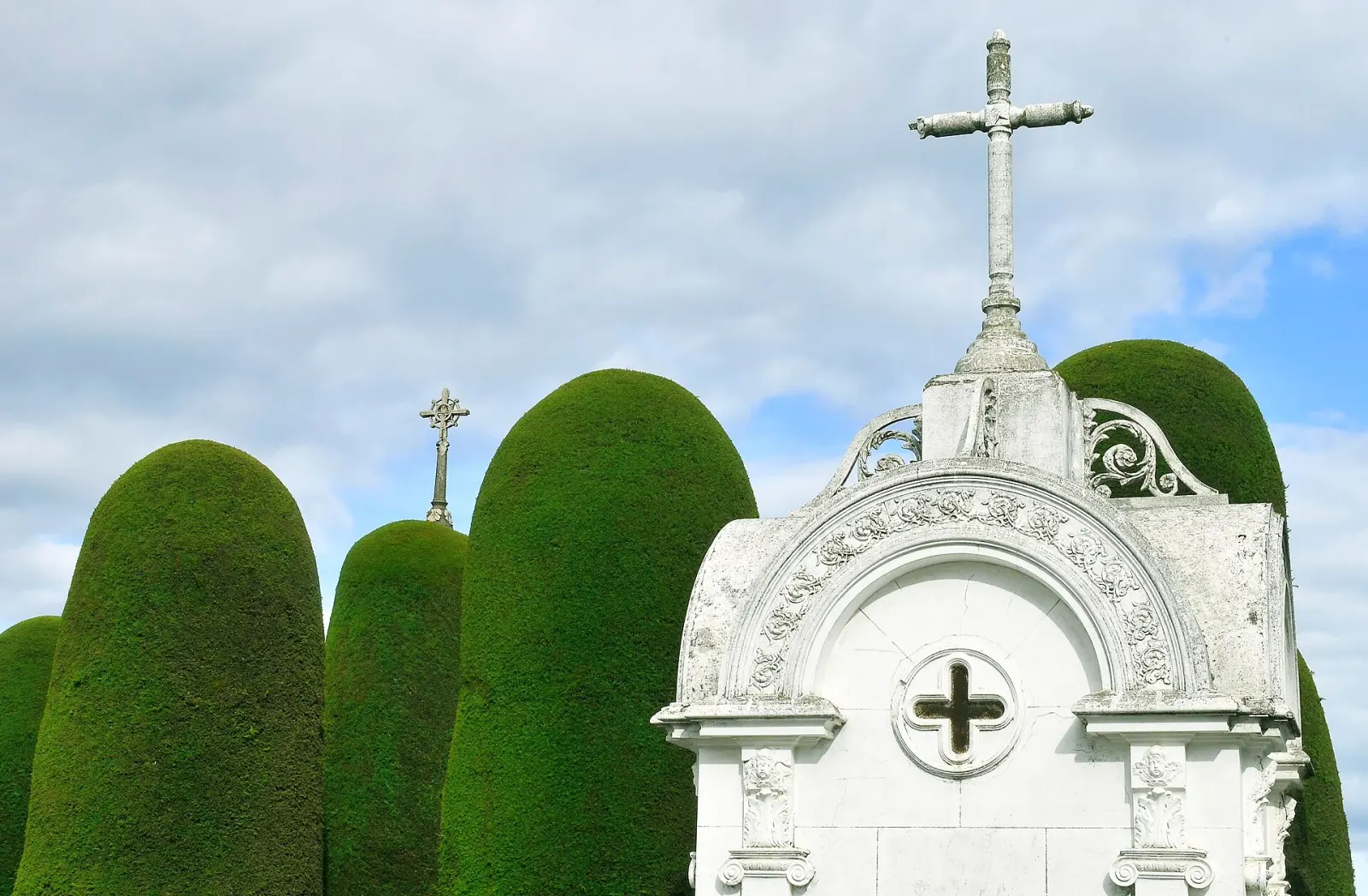
The first thing you see is the cypresses: more than six hundred, planted in rows over a century ago and clipped into cones. They line the avenues you follow through the cemetery and give it a serene, almost garden-like order, in a city where the wind rarely leaves anything still.
Who lies here
Walking it is reading the history of Magallanes in surnames. There are the mausoleums of the pioneer families, such as that of José Menéndez, an Asturian rancher and shipowner. And there are more than ten plots belonging to charitable societies, built for immigrants who had no family to bury them.
There are stories of the sea, too. Here rest the Norwegian whaling captain Adolf Andresen and Charles Milward, the English sailor who appears in Bruce Chatwin’s “In Patagonia.” Here is the memorial to the crew of HMS Doterel, the British gunboat that exploded in the harbor in 1881, of whose 155 crew members twelve survived. And here is Baldwin Spencer, the English anthropologist who died on Isla Navarino while studying the Yagán.
The Indio Desconocido
On one of the avenues there is a grave that is almost never alone. In 1929, on Isla Cambridge, today Isla Diego de Almagro, where marble was quarried, two men died: a man from Chiloé named Leal and an Indigenous man whose real name no one recorded; research suggests he was Kawésqar. They were buried together, and the circumstances of their deaths are still not entirely clear.
Years later, someone placed a marble slab on the grave with the inscription “Indio Desconocido” (Unknown Indian) and an epitaph by the poet José Grimaldi. In 1969 a bronze sculpture by Edmundo Casanova was added which, according to the Consejo de Monumentos Nacionales, represents all the Indigenous peoples of Patagonia.
The grave became a place of popular devotion. People leave candles, coins and plaques giving thanks for favors of health, family or love, and All Saints’ Day is when it receives the most visitors. It deserves to be approached in silence, with the same respect as any other grave.
Visiting
- Take your time. The main avenues can be covered in an hour; with two you’ll see it properly.
- Bring the route along. The cemetery has a heritage route through its main graves and a search tool for those buried there on its official website.
- It’s a working cemetery. Families come to visit their loved ones: keep your voice down, keep people out of your photos, and don’t sit or lean on the graves.
Last reviewed
See the full guide to Punta Arenas